
Can a Thyroid Nodule Be Treated Without Surgery?
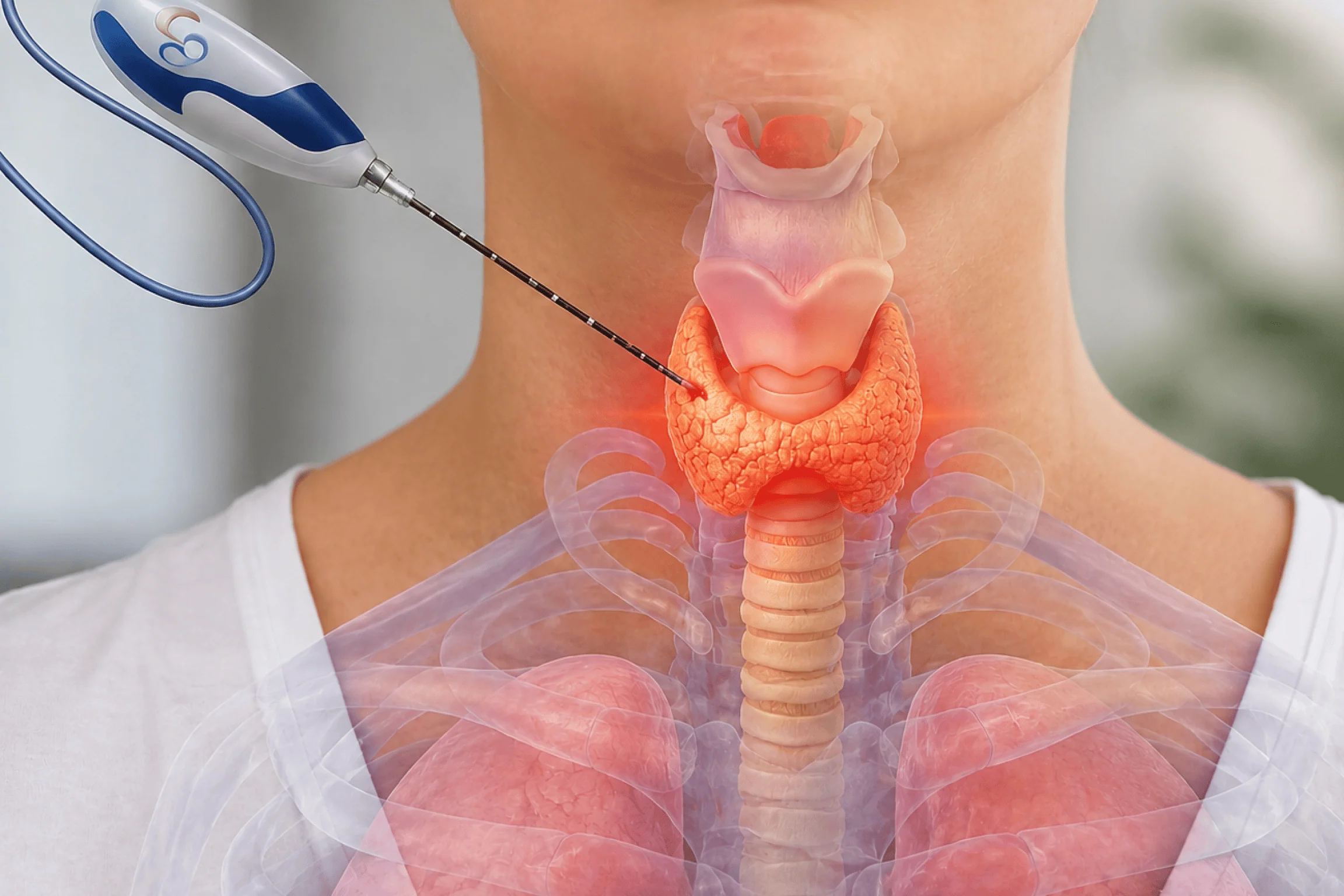
Yes — most benign thyroid nodules can now be treated without surgery
For decades, the standard answer to a symptomatic thyroid nodule was surgical removal — either the nodule, part of the thyroid, or the entire gland. That is no longer the only option. Radiofrequency ablation (RFA) and microwave ablation (MWA) are non-surgical procedures that shrink thyroid nodules from the inside, preserving the thyroid gland entirely.
Most patients with benign nodules are never told this option exists. This article explains what it is, who qualifies, what the results look like, and how it compares to surgery.
What Is a Thyroid Nodule?
The majority of thyroid nodules are benign. Fewer than 5% are malignant. The clinical challenge is identifying which nodules require treatment and which can be safely monitored.
How nodules are assessed — TIRADS and FNAC
When a thyroid nodule is found on imaging, the standard assessment uses two tools:
- TIRADS (Thyroid Imaging Reporting and Data System) — a standardised scoring system applied during ultrasound. It classifies nodules from TIRADS 1 (normal) to TIRADS 5 (high suspicion for malignancy) based on their ultrasound characteristics: composition, echogenicity, shape, margins, and echogenic foci. TIRADS score determines whether biopsy is indicated.
- FNAC (Fine Needle Aspiration Cytology) — a needle biopsy performed under ultrasound guidance. A thin needle is inserted into the nodule to collect a tissue sample for analysis. FNAC classifies the nodule as benign, indeterminate, suspicious, or malignant. This result determines the treatment pathway.
Benign nodules confirmed on FNAC — particularly those causing symptoms due to their size — are the primary candidates for non-surgical ablation.
When Does a Thyroid Nodule Need Treatment?
Not every thyroid nodule requires intervention. Active surveillance — monitoring with periodic ultrasound — is appropriate for nodules that are small, stable, and asymptomatic.
Treatment is indicated when any of the following apply:
- The nodule is causing compressive symptoms: difficulty swallowing, a sensation of pressure in the neck, hoarseness, or difficulty breathing
- The nodule is cosmetically significant — visible as a lump in the neck and causing distress
- The nodule is a functioning (autonomously hyperfunctioning) nodule producing excess thyroid hormone
- The nodule is growing on serial ultrasound — an increase of 20% or more in two dimensions
- FNAC results are indeterminate and the clinical picture warrants treatment over continued surveillance
Historically, any of these presentations led to a surgical referral. For most patients, that is no longer necessary.
What Is Thyroid RFA — Radiofrequency Ablation?
Radiofrequency ablation (RFA) is a minimally invasive, non-surgical procedure that destroys thyroid nodule tissue using controlled heat delivered through a thin electrode needle.
How the procedure works:
- Local anaesthetic is applied to the neck — no general anaesthesia is required
- A thin electrode needle is inserted into the nodule under continuous ultrasound guidance
- Radiofrequency energy is delivered through the needle tip, generating controlled heat within the nodule tissue
- The heat destroys the nodule cells while the surrounding normal thyroid tissue is preserved
- The procedure uses a ‘moving shot’ technique — the needle is repositioned within the nodule to ensure complete coverage
- Total procedure time is typically 30–60 minutes
- No incision. No stitches. No hospital stay required for most patients
What happens after RFA:
The treated nodule does not disappear immediately. Over the following weeks and months, the destroyed tissue is gradually absorbed and replaced by scar tissue. The nodule shrinks progressively:
- At 1 month: 30–40% volume reduction
- At 6 months: 50–80% volume reduction
- At 12 months: sustained reduction, with some nodules reducing by over 90%
Compressive symptoms — difficulty swallowing, pressure — typically improve within weeks as the nodule begins to shrink. The thyroid gland remains intact and continues to function normally.
What Is Microwave Ablation (MWA)?
Clinical outcomes are comparable between RFA and MWA. The choice between the two depends on nodule characteristics — size, location, vascularity — and operator expertise. Both are performed under ultrasound guidance, under local anaesthesia, without surgery.
What Is Microwave Ablation (MWA)?
| Thyroid RFA / MWA | Surgery (Thyroidectomy) | |
| Anaesthesia | Local | General |
| Incision / scar | None | Yes — neck incision |
| Hospital stay | Day procedure | 2–4 days |
| Recovery time | 1–2 days | 2–4 weeks |
| Thyroid preserved | Yes | Partial or complete removal |
| Lifelong medication | Usually not required | Required if gland fully removed |
| Nodule recurrence | Possible — retreatable | Minimal (gland removed) |
| Risk to vocal nerves | Very low | Small but present |
Who Is a Candidate for Thyroid RFA?
RFA is appropriate for most patients with benign, symptomatic thyroid nodules. Specifically, you are likely a good candidate if:
- Your nodule has been confirmed benign on FNAC
- The nodule is causing compressive symptoms or is cosmetically significant
- You want to preserve your thyroid gland and avoid lifelong thyroid hormone replacement
- You are not a suitable candidate for surgery due to other health conditions
- You had a previous thyroid surgery and have a recurrent nodule
RFA is not appropriate for malignant nodules. Confirmed thyroid cancer requires surgical management in most cases, though RFA may have a role in specific scenarios — particularly recurrent or metastatic disease in inoperable patients, assessed on a case-by-case basis.
Indeterminate FNAC results require individual clinical judgment. In some cases, RFA is offered as an alternative to diagnostic surgery; in others, repeat biopsy or surgical excision remains the recommended path.
Key point on thyroid function after RFA:
Because RFA targets only the nodule — not the surrounding gland — thyroid function is preserved in the vast majority of patients. Post-procedure thyroid hormone levels typically remain within normal range. This is one of the most significant advantages over surgery: patients who undergo total thyroidectomy require lifelong levothyroxine replacement. After RFA, most patients do not.
What About Autonomously Functioning Nodules (Toxic Nodules)?
RFA has shown effectiveness in reducing the functional activity of toxic nodules alongside their volume. Studies show normalisation of thyroid function in a significant proportion of patients following ablation. RFA is an emerging option for this indication, though radioiodine remains the more established non-surgical alternative for functioning nodules.
The choice between RFA and radioiodine for toxic nodules depends on nodule size, patient preference, pregnancy status, and local expertise. A specialist assessment is required.
The Role of FNAC — Understanding Your Biopsy Result
Before RFA can be recommended, the nature of the nodule must be established. FNAC is the tool that does this. Understanding your biopsy result is essential:
- Bethesda I (Non-diagnostic) — insufficient material; repeat FNAC is typically recommended
- Bethesda II (Benign) — the nodule is not cancerous; monitoring or ablation depending on symptoms
- Bethesda III (Atypia of undetermined significance) — indeterminate; management varies; may warrant repeat biopsy, molecular testing, or surgical excision
- Bethesda IV (Follicular neoplasm) — surgical excision is typically recommended to obtain a definitive diagnosis
- Bethesda V (Suspicious for malignancy) — surgery is the standard recommendation
- Bethesda VI (Malignant) — confirmed cancer; surgery is required in most cases
RFA is most clearly indicated for Bethesda II (confirmed benign) nodules with symptoms. The pathway for Bethesda III is evolving; some centres offer RFA as an alternative to diagnostic surgery in selected patients.
Frequently Asked Questions
Is thyroid RFA painful?
The procedure is performed under local anaesthesia. Most patients experience mild discomfort during the injection of anaesthetic and minimal sensation during the ablation itself. Post-procedure discomfort is typically mild — managed with standard analgesia — and resolves within 24–48 hours. The absence of a surgical incision means there is no wound pain.
Will I need thyroid medication after RFA?
In most cases, no. Because RFA targets only the nodule and preserves the surrounding thyroid tissue, thyroid hormone production is maintained. Thyroid function tests are checked at follow-up appointments to confirm stability. This contrasts with total thyroidectomy, which requires lifelong levothyroxine replacement.
Can the nodule come back after RFA?
The ablated portion of the nodule does not regrow. However, a small rim of tissue at the periphery of the nodule may remain after ablation, and in some cases this can regrow over time — reported in approximately 5–10% of cases at long-term follow-up. If regrowth occurs, repeat RFA is an option. The overall retreatment rate is low.
How many sessions of RFA are needed?
Most benign nodules are treated in a single session. Larger nodules — typically above 4–5 cm — may benefit from a second session to achieve maximal shrinkage. The number of sessions required is assessed on the post-procedure ultrasound at the 3–6 month follow-up.
Is thyroid RFA available in Bangalore?
Yes. Thyroid RFA is performed by interventional radiologists with specific training in head and neck ablation at select centres in Bangalore. It is important to confirm that the procedure is being performed by a specialist with documented experience in thyroid ablation, as the proximity of the nodule to the recurrent laryngeal nerve and other structures requires precise technique.
Is thyroid RFA covered by insurance in India?
Coverage varies by insurer and policy. Some major insurers cover thyroid ablation when there is documented clinical indication — confirmed benign nodule with compressive symptoms or cosmetic impact. Pre-authorisation documentation, including FNAC results and ultrasound reports, is typically required. Your interventional radiology team can assist with this process.
The Bottom Line
A benign thyroid nodule that requires treatment does not automatically require surgery. Radiofrequency ablation is a clinically established, evidence-backed non-surgical option that shrinks thyroid nodules by 50–80% at 6 months, relieves compressive symptoms, and preserves the thyroid gland — without an incision, without general anaesthesia, and without lifelong medication in most cases.
The prerequisite is a confirmed benign nodule on FNAC and TIRADS assessment. If that confirmation exists and your nodule is causing symptoms, a consultation with an interventional radiologist should be part of your decision-making — before you consent to surgery.
Know before you consent.
Diagnosed with a thyroid nodule?
Dr. Deepmala consults on thyroid nodule assessment and non-surgical treatment including RFA and MWA.
Book a consultation to understand whether ablation is right for your nodule.
